Phone:
(877)-898-5303
Physical address:
One Glenlake Parkway Suite 650 &, 700, Atlanta, Georgia 30328

Phone:
(877)-898-5303
Physical address:
One Glenlake Parkway Suite 650 &, 700, Atlanta, Georgia 30328

If you are building a large home array, a farm or commercial project, or you are an installer who stocks panels, buying solar panels by the pallet is usually cheaper per watt than buying single modules. It also changes how you shop. You compare price per pallet and price per watt, you plan freight, and you commit to a quantity. This guide explains what is on a pallet, how to read pallet prices, and what to check before you pay.
Key takeaways
A pallet is the standard freight unit for wholesale solar panels. The modules are stacked on edge or flat, strapped, wrapped and shipped as one load. Because manufacturers pack to their own specification, there is no single industry number. The pallet counts we see in current listings include 27, 30, 31, 35, 36 and 37 panels, depending on module size.
That is why searches such as “solar panel pallet”, “solar panels by the pallet” and “pallet of solar panels” all lead to the same question: how much power am I actually buying? The answer is simple arithmetic:
A 36-panel pallet of 415 W modules, for example, delivers 14,940 W, or about 14.9 kW. That is enough for a large residential system or part of a small commercial one.
The table below uses real listings from the wholesale solar panels by the pallet category, checked in early October 2026. Prices and stock change often, so treat them as a snapshot of how pallet pricing works, not as a quote.
| Panel (example listing) | Panels per pallet | Pallet power | Pallet price | Price per watt |
|---|---|---|---|---|
| JA Solar 340 W, 72-cell polycrystalline | 27 | 9.18 kW | $2,215.08 | $0.24/W |
| Regitec 415 W, 108-cell PERC | 36 | 14.94 kW | $3,842.28 | $0.26/W |
| Imperial Star 405 W, 108-cell all-black (3-pallet minimum) | 36 | 14.58 kW | $4,454.28 | $0.31/W |
| Solarever 450 W, 96-cell N-type bifacial, all-black | 36 | 16.2 kW | $5,637.60 | $0.35/W |
| CW Energy 450 W, 108-cell TOPCon, assembled in the USA | 35 | 15.75 kW | $5,599.65 | $0.36/W |
Two patterns stand out. First, cheaper pallets are often older cell technology or clearance stock, such as the polycrystalline 340 W modules. Second, in this sample the N-type, bifacial and US-assembled pallets cost more per watt, although some large 144-cell N-type bifacial pallets in the same category list as low as about $0.27 per watt, and some US-content pallets reach about $0.52 per watt. For some buyers the extra efficiency, warranty or domestic-content status justifies the premium.
Buying wholesale solar panels by the pallet is usually cheaper per watt than buying single modules, because freight, packing and handling are spread across the whole load. The trade-off is that you buy a fixed quantity.
If you are unsure how many panels your home needs, size the system first and then decide whether a pallet fits. A pallet of 36 modules at 400 W or more is often more than a typical small home needs, but it can be a good match for larger homes, farms and small businesses. The commercial solar panel range is the usual starting point for the latter.
Solar panel cost per watt is the cleanest way to compare, but only if you compare like with like. Before you decide that one pallet is cheaper than another, check these five points.
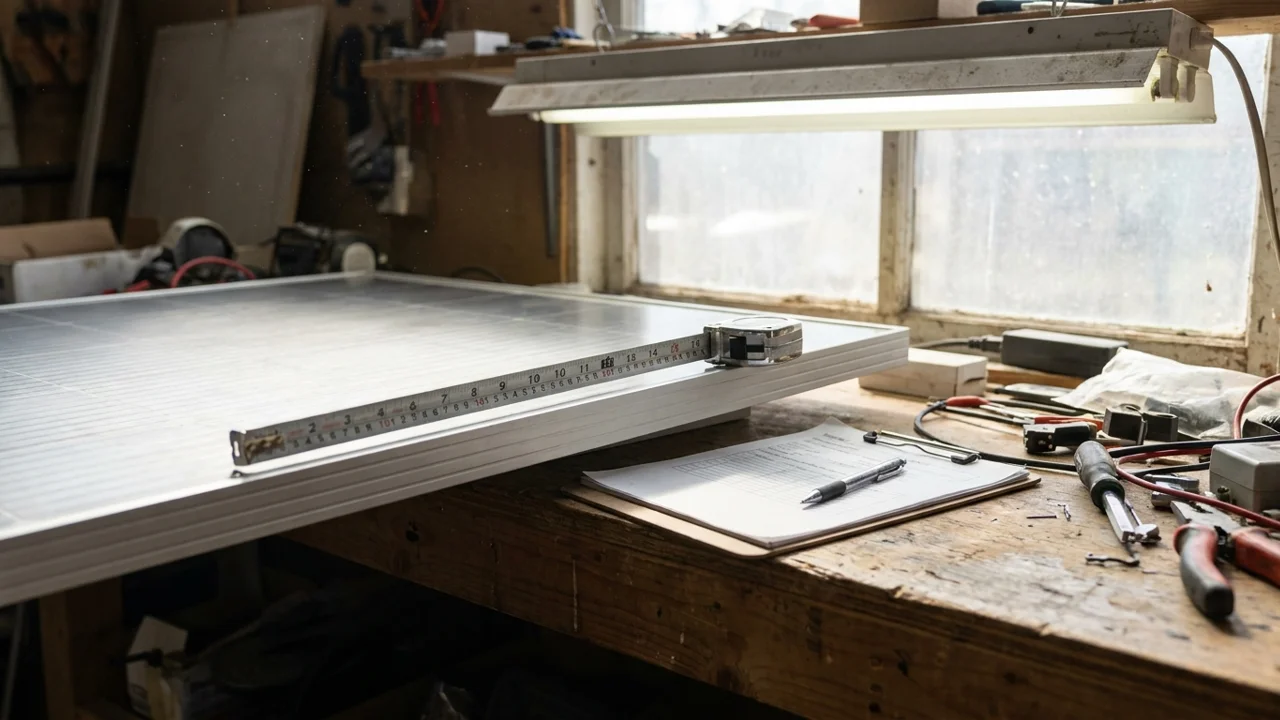
Panel dimensions and weight affect your racking, your roof or ground structure, and how you move the pallet. Typical 108-cell panels in the 400–450 W class are roughly 1.7 m by 1.1 m (about 68 by 45 in), and 144-cell panels in the 500 W-plus class are longer, around 2.3 m (about 90 in). A 108-cell module in the 400–450 W class commonly weighs about 21 kg (roughly 46–47 lb), while 144-cell bifacial modules in the 500 W-plus class weigh about 31 kg (roughly 68 lb). A full pallet of 108-cell panels therefore typically weighs around 1,700–1,900 lb (about 800 kg), and a pallet of 144-cell panels can exceed 2,000 lb.
Always read the datasheet for the exact model. The dimensions and weight there, not a general rule, decide your mounting rails, your installer’s lifting plan and the freight class.
Solar panel shipping is easy to underestimate. Before you buy, ask the seller:
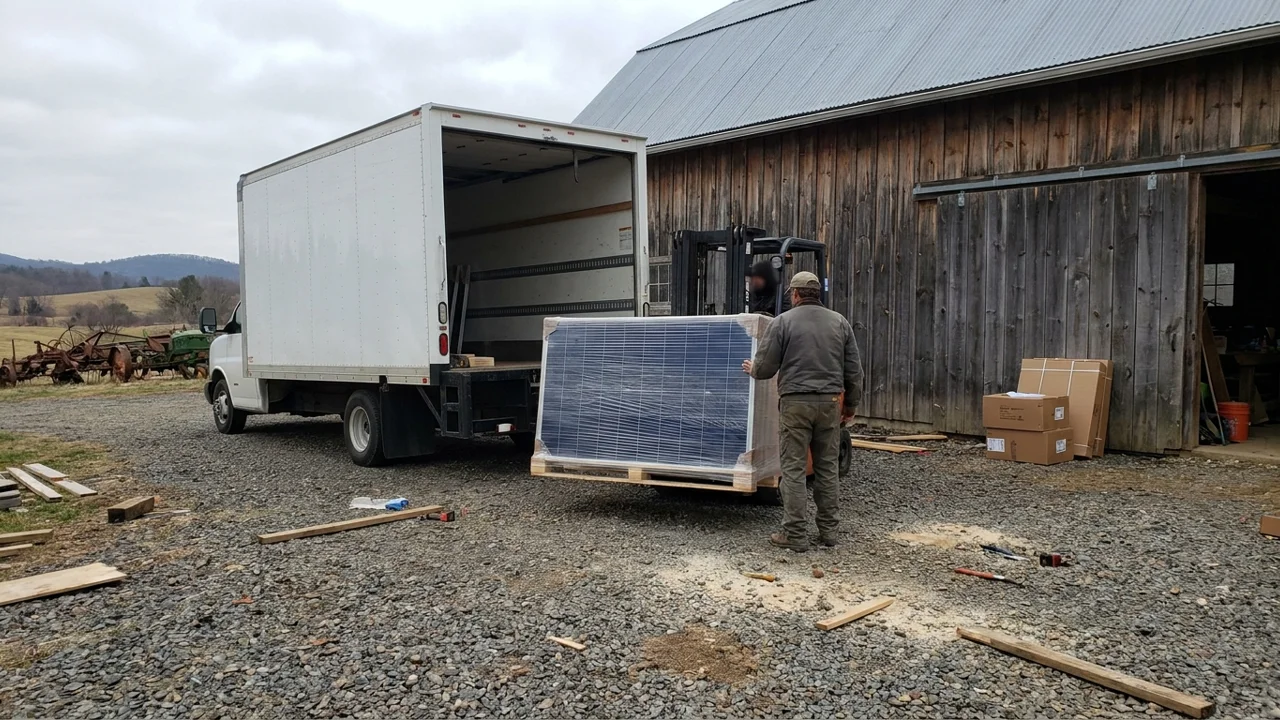
Inspect the pallet before you sign the delivery receipt. Look for crushed corners, torn wrap and cracked glass. Note any damage on the receipt and photograph it, then report it to the seller immediately. If you cannot store the panels indoors, keep them covered, off the ground and out of standing water, and follow the manufacturer’s storage guidance.
If you also need inverters, batteries or a complete kit, ask the supplier whether it can match them to the panels. A mismatch between a panel’s open-circuit voltage and an inverter’s or charge controller’s input limit is a costly mistake on large orders.
Panels by the pallet can cut your cost per watt, but only if you buy the right panel at the right delivered price. Start with your system size, compare candidate pallets by price per watt, read the datasheet and warranty, and plan the freight. If you want help, browse the solar panels for sale range or look at specific brands such as Qcells, Longi, REC and JA Solar.
Most pallets hold roughly 26 to 37 modules, depending on panel size and the manufacturer’s packing. Current wholesale listings include pallets of 27, 30, 31, 35, 36 and 37 panels, so always check the listing.
It depends on the panel. In early October 2026, pallet listings ranged from about $2,200 for 27 older 340 W panels (about $0.24 per watt) to more than $10,000 for a pallet of 590 W panels, with US-content pallets reaching about $0.52 per watt. Freight may be extra.
Usually yes on a price-per-watt basis, because freight, packing and handling are spread across the whole load. It only makes sense if you can use the quantity and handle the delivery.
Multiply the panels per pallet by the watts per panel to get total watts, then divide the pallet price by that number. For example, $3,842 divided by 14,940 W is about $0.26 per watt.
Modern panels in the 400–590 W class usually weigh about 21–32 kg (roughly 46–70 lb) each, with large 144-cell bifacial modules at the heavy end. Check the datasheet for the exact figure.
Yes, but confirm the grade, the warranty and who supports it, and compare the price per watt with new panels before you decide.