Solar Panels in South Carolina: Costs, Net Metering, Incentives and What to Buy
South Carolina still offers a 25% state income tax credit for solar, subject to annual limits.
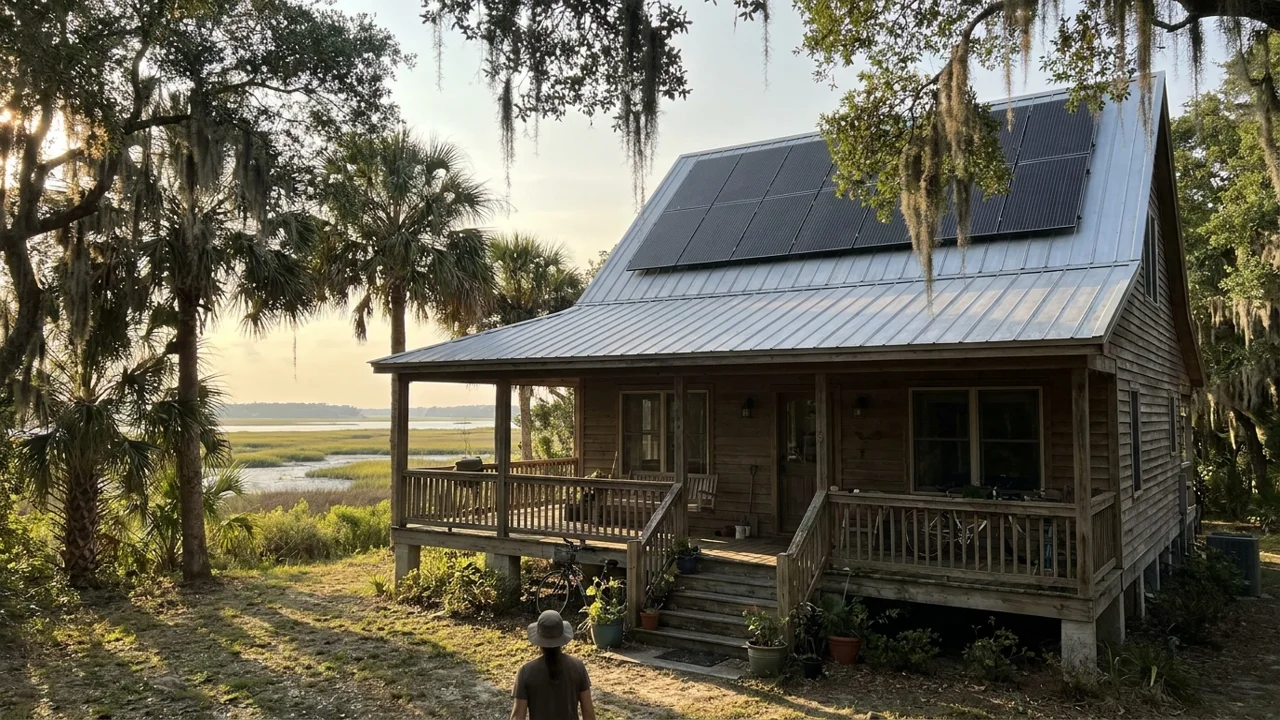
South Carolina still offers a state income tax credit for solar, and its sun resource is strong, at about 1,560 to 1,600 kWh per installed kW per year. At the same time, net metering for new customers has moved to utility-specific “Solar Choice” tariffs, and hurricanes and salt air shape what equipment lasts. This guide covers prices, net metering, the tax credit and its limits, utility rebates and practical equipment choices for homes, farms and businesses in South Carolina.
Key takeaways
South Carolina homes paid an average of 15.47 cents per kWh in July 2026, up from 14.70 cents a year earlier (EIA).
The state solar tax credit equals 25% of the cost of a system you own, but you can claim no more than $3,500 per facility or 50% of your state tax liability in any year, whichever is less. Unused credit carries forward for up to 10 years.
The federal Residential Clean Energy Credit (Section 25D) is not available for systems placed in service after December 31, 2025.
Customers who applied for net metering before June 1, 2021 keep the old terms until May 31, 2029; later applicants use Solar Choice tariffs. Santee Cooper sets its own export credit.
Santee Cooper offers a $0.95 per watt (AC) rebate, capped at 6 kW AC, for systems completed between December 1, 2025 and November 30, 2026, while funding lasts.
Solar in South Carolina at a glance
Metric
What to know
Source/date
Average residential electricity price
15.47 ¢/kWh (July 2026), up from 14.70 ¢/kWh in July 2025; U.S. average 18.31 ¢/kWh
Applied before June 1, 2021: original net metering until May 31, 2029. Applied later: Solar Choice metering tariffs set by the Public Service Commission. Santee Cooper: exports credited at $0.0415/kWh plus a $10 monthly charge
About 1,600 kWh per kWp per year in Charleston and 1,560 to 1,570 in Columbia and Greenville (roughly 5.3 to 5.4 peak sun hours on an optimally tilted panel)
South Carolina residential electricity averaged 15.47 cents per kWh in July 2026, about 5% higher than a year earlier and below the U.S. average of 18.31 cents, according to the EIA. Businesses paid 11.61 cents. Because summer air-conditioning load lines up well with solar output, a well-sized system offsets some of the most expensive usage of the year.
Your utility determines your solar terms. Dominion Energy South Carolina serves much of the Midlands and the Lowcountry, Duke Energy serves much of the Upstate and Pee Dee, and Santee Cooper, the state-owned utility, serves customers in Horry, Berkeley and Georgetown counties. Electric co-ops cover large rural areas and set their own rules.
Net metering and selling power back
South Carolina’s 2019 Energy Freedom Act (Act 62) rewrote net metering (S.C. Code §58-40-20):
Legacy customers. Customer-generators who applied before June 1, 2021 may keep their original net metering terms until May 31, 2029, including subsequent owners of the home.
Solar Choice. For applications received after May 31, 2021, the Public Service Commission sets “solar choice metering” tariffs for each investor-owned utility. The law tells the commission to remove cost shifts to non-solar customers as far as practicable while preserving access to solar, and to let customers use their own solar energy behind the meter without penalty. Dominion Energy and Duke Energy each publish their own Solar Choice terms.
Santee Cooper does not offer one-to-one net metering. Solar energy you use at home offsets the full retail rate, while exports are credited at $0.0415 per kWh under its Distributed Generation Rider (DG-25), which also carries a $10 monthly customer charge (Santee Cooper 2026 program manual).
Under every one of these structures, solar you use yourself is worth more than solar you export. Size the array to your actual usage, and consider storage if you want backup power or more self-consumption. The Avolta guide to batteries and backup power explains the options.
Incentives in South Carolina
State income tax credit (25%). Under S.C. Code §12-6-3587, you can claim 25% of the cost of buying and installing a solar energy system on a facility in South Carolina that you own. The credit in any one year may not exceed $3,500 per facility or 50% of your state tax liability for that year, whichever is less, and you can carry the excess forward for up to 10 years. You cannot claim it before installation is complete. For example, a $24,000 system earns a $6,000 credit, which could be taken as $3,500 in the first year and $2,500 the next, if your tax liability allows. Claim it on Form TC-38. The law also says a solar system must be certified for performance by the Solar Rating and Certification Corporation or a comparable entity endorsed by the State Energy Office, so ask your installer for the documents you will need.
Santee Cooper Solar Home rebate. The rebate is $0.95 per watt of AC output, capped at 6 kW AC per meter, for systems completed between December 1, 2025 and November 30, 2026. Installation must be done by a Santee Cooper Solar Electric Trade Ally with a NABCEP-certified professional, and funding is first-come, first-served (2026 program manual).
Federal homeowner credit ended. The IRS says the Residential Clean Energy Credit is not available for property placed in service after December 31, 2025. Ignore any quote that still lists a “26%” federal refund.
Business credits are narrowing. Commercial solar facilities that begin construction after July 4, 2026 must be placed in service by the end of 2027 to qualify for the Section 48E or 45Y credits (IRS Notice 2025-42). Guidance on beginning of construction has been challenged in court, so check with a tax professional.
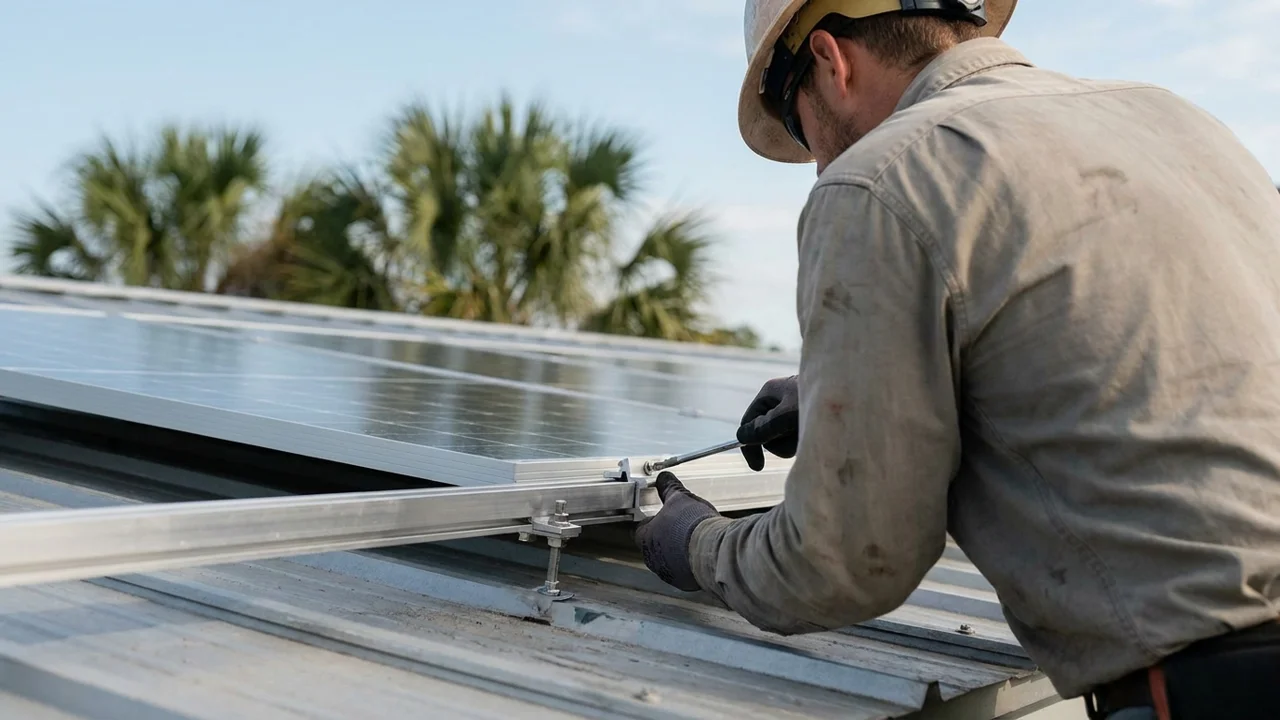
Near the coast, wind-rated racking and corrosion-resistant hardware matter as much as the panel itself.
Climate and what it means for your equipment
NOAA counted 101 billion-dollar weather disasters in South Carolina from 1980 to 2024, including 25 tropical cyclones, 44 severe storms and 13 winter storms. Tropical cyclones accounted for 66.7% of the total cost (NOAA NCEI).
Hurricane wind. On the coast, choose racking and roof attachments with engineering for your site’s design wind speed and exposure category, and check the module’s certified mechanical load rating. Metal roofs need attachments approved for that roof profile.
Salt air. Within reach of sea spray, look for modules tested for salt mist corrosion (IEC 61701), stainless fasteners and inverters rated for outdoor coastal installation.
Heat and humidity. A panel rated −0.30%/°C running 35 °C above the 25 °C test condition produces about 10.5% less than its rating. Compare temperature coefficients and keep airflow under the modules.
Severe storms. Hail and straight-line winds appear among NOAA’s 44 severe storm events, so confirm your homeowner’s insurance covers the array.
Outages. After a storm, a standard grid-tied system stays off while the grid is down. Backup needs a battery or a hybrid inverter designed to island safely.
What to buy in South Carolina
Modules: UL 61730 listing, a strong mechanical load rating for coastal sites, salt mist testing near the ocean and a low temperature coefficient.
Inverters and batteries: a hybrid inverter with storage adds backup for hurricane season and raises self-consumption under Solar Choice or Santee Cooper’s export rate.
Racking: wind-rated, with corrosion-resistant hardware on the coast.
Quantity: farms, large homes and installers can lower cost per watt with solar panels by the pallet; the Avolta pallet guide shows how to compare offers. Businesses can start with commercial solar panels.
Permits: expect building and electrical permits from your city or county.
Interconnection: apply to Dominion Energy, Duke Energy, Santee Cooper or your co-op before installation. Santee Cooper requires an approved Interconnection Request Application before installation and charges residential customers a $100 application fee (2026 program manual).
Solar Choice terms: ask your utility which Solar Choice tariff and rate schedule will apply before you sign a contract.
Tax records: keep invoices, proof of completion and certification documents for Form TC-38.
Yes. You can claim 25% of the cost of a solar system you own on a South Carolina facility, limited to $3,500 per facility or 50% of your state tax liability in any year, whichever is less, with up to 10 years to use the rest.
Is the South Carolina solar credit “$3,500 a year until 25% is reached”?
Roughly, but with two catches: each year’s claim is also capped at 50% of your state tax liability, and any unused credit expires after 10 years of carryforward.
Does South Carolina have net metering?
Customers who applied before June 1, 2021 keep original net metering until May 31, 2029. Newer customers of Dominion Energy and Duke Energy use Solar Choice tariffs, and Santee Cooper credits exports at $0.0415 per kWh.
Can I still get the federal solar tax credit in South Carolina?
Not for a home system placed in service after December 31, 2025, according to the IRS. Business credits follow different rules; check with a tax professional.
What equipment works best on the South Carolina coast?
Wind-rated racking and attachments, modules with strong mechanical load ratings and salt mist testing, stainless hardware and, if you want power after storms, a battery with a hybrid inverter.